

Peristaltic pumps are widely used across labs, cleanrooms, and industrial environments for accurate and contamination-free fluid transfer. These pumps are self-priming by design, but manually priming them before use helps achieve more consistent flow and clears the lines of trapped air. Setting up and priming your pump correctly can avoid dosing errors, prevent product waste, and maintain reliable system performance. This guide walks you through step-by-step instructions to help ensure smooth operation and extend the life of your pump and tubing.
Tools and Materials Needed
Tubing
Choose tubing designed for peristaltic pumps and ensure it matches the inner diameter and wall thickness requirements of your pump head. Cole-Parmer offers a wide range of tubing options suitable for various pumps and applications. You can also use the Tubing Selector Tool to quickly find the exact formulation and size needed for your system, and confirm compatibility with the Tubing Compatibility Database.
Fluid Reservoir and Waste Container
Have a designated source container for your fluid and a waste container to collect excess fluid during priming. Cole-Parmer provides a variety of beakers, carboys, and containers designed for lab and industrial fluid handling.
Safety Gloves and Goggles
Personal protective equipment (PPE) is essential when handling fluids to protect the operator and the product. Explore Cole-Parmer’s selection of safety gloves and eyewear to keep your team protected.
Step-by-Step Guide to Setting Up a Peristaltic Pump
- Mount the pump securely
- Place the pump on a flat, stable, vibration-free surface or mount it as directed by the manufacturer.
- Allow airflow around the pump to dissipate heat.
- Ensure the ambient temperature does not exceed the manufacturer’s specifications.
- Position the pump near the fluid source and waste container for easy tubing connection. Keep tubing runs as short and direct as possible to minimize back pressure and flow variability, while leaving enough slack to fit through the pump head and reach the inlet/outlet.
- Check tubing compatibility and dimensions
- Confirm the tubing’s chemical resistance against the fluid being transferred using the Tubing Compatibility Database.
- Verify inner diameter, wall thickness, and overall size match the pump head specifications for accurate flow rates.
- Load and align the tubing correctly

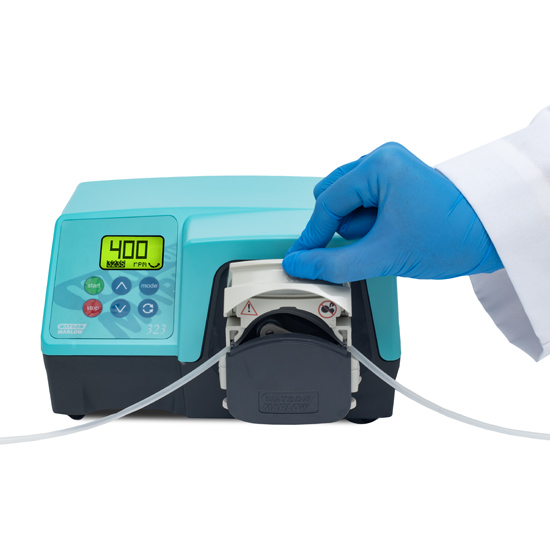
- Open the pump head and insert the tubing into the rotor channel.
- Make sure the tubing sits evenly without twists or kinks.
- Secure the tubing using the pump head’s clamps. Check that the tube is not crushed or overstretched.
- If the pump head has adjustable occlusion, set the compression correctly. Too much compression can damage tubing and reduce flow; too little can cause leaks and backflow.
- If the pump supports clockwise/counterclockwise rotation, arrange inlet/outlet in the most convenient orientation.
- Close the pump head securely to prevent slippage.
How to Prime a Peristaltic Pump
Priming is the process of filling the tubing with fluid and removing trapped air before operation. While peristaltic pumps are self-priming, performing a deliberate priming step allows for more consistent flow and ensures the tubing is completely cleared of air.
Manual Priming vs. Automatic Priming
- Manual priming: Turn the pump on at a high speed and let it run until the flow becomes consistent and steady.
- Automatic priming: Some pumps feature a dedicated priming function to run fluid at high speed until the tubing is full.
Run Fluid Through Tubing to Eliminate Air
- Connect the tubing to the fluid source and waste container.
- Run the pump at a high speed until fluid displaces all air.
- Observe the outlet until a continuous, bubble-free stream appears.
Adjust Flow Rate
- Begin priming at a high speed for quick, complete removal of air.
- Once priming is complete, adjust the pump to the application’s required flow rate.
Troubleshooting Common Setup and Priming Issues
Tubing Slippage or Leaks
Tubing may slip or leak if it is not loaded correctly or if the tubing material has become worn out. This can cause inconsistent flow and potential contamination.
- Check that the pump head is closed properly.
- Ensure tubing is the correct size and not overly worn.
Pump Not Drawing Fluid
If the pump is not drawing fluid, the issue may stem from an empty source container, blockages, or incorrect pump rotation. This leads to stalled operation and reduced productivity.
- Verify the fluid source is filled and connected.
- Check for blockages or collapsed tubing.
- Confirm rotation direction matches fluid flow.
- Ensure the proper size tubing is used based on the manufacturer’s specifications.
Air Bubbles in the Line
Air bubbles can cause dosing inaccuracies and interruptions in fluid delivery. They are often introduced during setup or if connections are not properly sealed.
- Re-prime the pump at a low speed until bubbles are cleared.
- Ensure all tubing connections are airtight.
FAQ About Peristaltic Pump Setup
What happens if I don’t prime my pump?
Peristaltic pumps are self-priming and do not require special priming procedures to draw fluid into the tubing. However, if a peristaltic pump is not primed, air pockets may cause dosing inaccuracies, interrupted flow, or contamination risk in sensitive processes.
How often should I replace the tubing?
Tubing replacement frequency depends on material, flow rate, and chemical compatibility. In lab and cleanroom settings, tubing should be inspected regularly and replaced at the first sign of wear, cracks, or reduced performance. For more information, read: 5 Signs It’s Time to Replace Your Tubing.
Can I reverse the flow in a peristaltic pump?
Yes. Most peristaltic pumps allow reversible flow by changing the motor direction, making them useful for emptying lines or preventing backflow. Changing the flow direction can also allow for a more flexible setup.
Summary
Correct setup and priming of a peristaltic pump ensures accurate fluid transfer, reduces contamination risk, and extends both pump and tubing life. Cole-Parmer offers a comprehensive portfolio of peristaltic pumps and the Tubing Compatibility Database to help you select the right pump and tubing for your application. By following proper procedures and using the right resources, you can maintain consistent performance in lab, industrial, or cleanroom environments.