
Ultrasonic Cleaners use cavitation, created by ultrasonic waves, to scrub objects made of nonabsorbent materials in the research, pharmaceutical, printing, electronics, engineering, and automotive industries. Higher frequency models clean more gently, precisely, and reliably. Some cleaners offer digital timers, power tracking, sleep mode, and other features for critical cleaning applications.
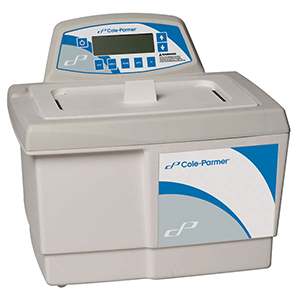
Cole-Parmer® Ultrasonic Cleaner with Digital Timer and Heater, 3/4 Gallon
Operating ultrasonic cleaners effectively requires selecting the appropriate solution. What gets in the way of optimal performance? Our technical application specialists advise to avoid the following when using an ultrasonic cleaner:
- Do not place parts or containers directly on the bottom of the cleaning tank—use a tray or wire to suspend items.
- Don’t allow the cleaning solution level to drop more than one inch below the top of the tank.
- Never use alcohol, gasoline, or flammable solutions. Doing so could cause a fire or explosion. Use only water-based solutions.
- Do not ever use mineral acids. These could damage the tank.
- Failure to comply with these cautions will void your warranty.
Decreased cavitation or cleaning action can result if:
- The cleaner is not full enough (always follow directions about how full one should fill the cleaner)
- One is using water or some other cleaning agent that is not intended for use as an ultrasonic cleaning solution. Also, even with a good cleaning solution, the solution has to be degassed by running the cleaner for approximately 10 minutes prior to use. Otherwise you will also get decreased cavitation.
You can test the cavitation of your ultrasonic cleaner by performing an aluminum foil test: Suspend a small piece of aluminum foil in your cleaner and run for about three minutes. If the cleaner is working properly, the foil should be dimpled or may even have holes. If not, see the guidance above for actions that can cause decreased cavitation.
View our selection of <a href=/c/ultrasonic-cleaners”>ultrasonic cleaners.
What precious stone should not be treated uin an ultrasonic cleaner? thank you
Hi Stanley:
Thank you for your question. I forwarded your information to our application specialists. They will be in contact with you. In the meantime, you can always call 1-800-323-4340 for immediate assistance.
Can you clean gun parts in the cleaner using the brass shell case cleaner fluid?
Hi Neil:
I sent your question to our technical experts. They will get back to you as soon as possible. In the meantime, you can always contact us at 1-800-323-4340 if you need an immediate answer.
Can you clean Big Blue Blocks (waterproof foam blocks) that are manufactured by Imagination Playground?
Hi James:
We suggest you contact the manufacturer of the blocks to find out the best way to clean them.
Thanks,
Karen
Could you use a food grade mineral oil in an ultrasonic cleaner to help prevent rust on metal components.
Hi Lincoln:
I sent your question to our technical experts and they will get back to you as soon as possible. In the meantime, if you immediate assistance, please contact us a 1-800-323-4340. Thanks!
Can you clean eyeglasses with coatings
Hi Mike:
Thanks for your question. It would be best for you to check with the eyecare center where you purchased your glasses to find teh best way to clean your specific pair of eyeglasses. It’s also a good idea to read the manufacturer’s directions on your specific ultrasonic cleaner to see if that is even possible with the cleaner you have. There are several variables to consider as well. You need to know the material of your glasses and the coating material. We wouldn’t want you to ruin your eyeglasses.
I am a glass blower/chemist and have been tasked with fabricating some VERY small ion exchange columns for which I must produce a Pyrex frit disc only four millimeters in diameter by 1 mm thick with careful grinding. My question is this; to get the residue of the glass powder resulting from the grinding out of the frits do you think is possible that an ultrasonic bath might damage the fritted discs. I would put them in my ultrasonic bath in the unmounted state i e before they are sealed into the glass tube.
Hi Dean:
We will forward your question to our technical experts. Thanks for your question.