
Our technical support team has assembled a list of tips that cover everything from fittings to flowmeters. Here’s our top ten:
- Select immersion heaters based on the wattage you require. This formula can be used as a guide to estimate your wattage requirements. For water: kW= (gallons x temperature rise (ºF)) /(325 x heat-up time (hours))
- Gas bubbles sometimes form on small bore tubings and fittings due to the
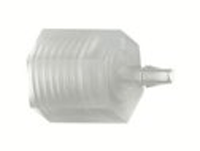 pressure drop that occurs as the liquid passes through the office of the connecting fitting. Try boiling the water used to make the solution to remove dissoved gasses from the water.
 - Remember, when selecting a pipe thread fitting, the outside diameter of the pipe does not equal the NPT size.
- To convert parts per million (ppm) to parts per thousand (ppt) when measuring total dissolved solids or salinity, divide the value by 1000 or move the decimal point to the left three spots.
- For the ½” and ¾” sanitary fittings, the outer diameter of the flange is the same, and uses the same clamp size. Similarly, the 1” and 1 ½” sanitary fittings also have the same outer diameter and therefore use the same clamp size.
- When using a Buchner funnel for vacuum filtration, you may need f
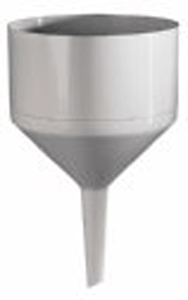 ilter cones, which provide a good seal with the top of the flask.
 - Which thermocouple type probe do you have? Thermocouple types are color coded for a specific type (i.e. yellow is type K, blue is type T, black is type J and purple is type E).
- Hose barb fittings are for flexible tubing (such as silicone or Tygon) and are sized according to the inner diameter of the tubing they connect with. Compression fittings are for rigid tubing (such as PTFE and polypropylene) and are sized according to the outer diameter of the tubing they connect with.
- Vortex flowmeter technology requires a positive back pressure to prevent cavitation.
- Another name for a rotameter is a variable area flowmeter.

Be the first to comment on "10 Tech Tips for Today"