
Our technical experts field questions regularly about ph testers and meters—how to use them, what electrodes to use with them, and other related questions. Here are answers to some of the most common:
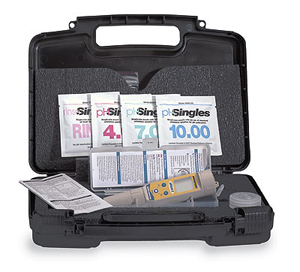
Oakton® Waterproof pHTestr 10 Pocket pH Tester and Calibration Kit
Q: When ordering a pH meter, what accessories do I need to start measuring?
A: You will need a pH electrode and at least two pH buffers, one at pH 7 and the other at either pH 4 or 10. Performing a 3-point calibration offers the best accuracy; in a 2-point calibration the 2nd point selected should be the closest to the sample value.
Q: When is a double-junction electrode better than a single-junction electrode?
A: Single-junction electrodes should be considered primarily for use with clean water samples. In dirty samples containing particulates, proteins, sulfides, and Tris buffers, a double-junction electrode is protected from having the second junction becoming clogged.
Q: What is the difference between a combination electrode and a sensing electrode with a reference half-cell?
A: A combination electrode works in virtually all pH applications. It combines the reference and sensing elements into a single electrode. The separate sensing electrode with reference half-cell combination is rarely used as it is bulky and not convenient.
Q: Can I measure the pH of a gas?
A: The only way to measure the pH of a gas is to dissolve it in distilled water and measure the mixture. Technically, the pH of the distilled water/gas mixture will be that of the gas.
Q: How often should I calibrate my pH meter?
A: Calibrate your meter prior to each use or set of uses at least once per four hours of use. Also, changing electrodes requires recalibration. Calibration corrects for inconsistencies inherent in all electrodes, particularly as they age or become contaminated.
Q: What is dead band?
A: “Dead band” refers to an area of a signal range (or band) where no action occurs. In pH control systems, the purpose is to prevent frequent turning on and off of pumps or valves which tends to shorten the life of the equipment. Dead band is different from hysteresis. With hysteresis there is no dead zone, the output is always in one direction or another.
View our selection of ph testers and meters.
Be the first to comment on "Answering Your pH Tester and Meter Questions"