
Although Infrared thermography, or thermal imaging use has increased recently within commercial and industrial applications, it has a long history beginning in the 1800s when Sir William Herschel discovered infrared.
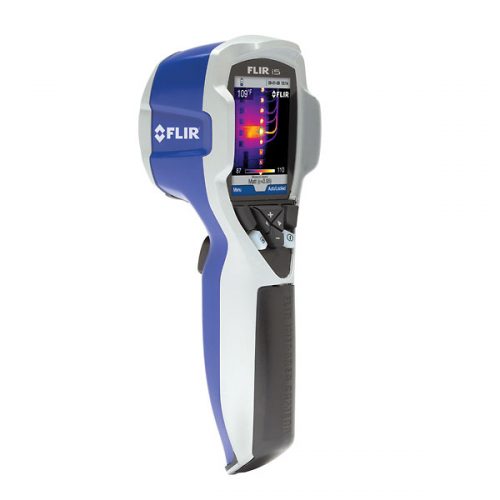
Flir i3 Entry Level Thermal Imagers
Timeline:
- Astronomer Sir William Herschel discovered infrared in 1800
- 1950-1960 Single Element Detectors (Line Images)
- 1970 Philips and English Electronic Valve (EEV) developed Pryo-Electric tube. First Naval Thermal Imager used by the Royal Navy for shipboard firefighting.
- 1978 Raytheon patented ferroelectric infrared detectors using on Barium Strontium Titanate (BST)
- Late 1980’s Microbolometer technology developed.
How it works:
Thermal imaging cameras convert the energy in the infrared wavelength (9,000 to 14,000 nanometers) into a visible light display, making it possible to view the environment without visible illumination. The thermal imaging camera performs a series of mathematical algorithms and builds a visible picture, usually in a JPG format. The image shows the viewer an approximation of the temperature at which the object is operating rather than detecting the actual temperature.
All objects above absolute zero emit thermal infrared energy, so thermal cameras can passively see all objects, regardless of ambient light. However, most thermal cameras only see objects warmer than -50°C. The amount of radiation emitted by an object increases with temperature; therefore, thermography allows one to see variations in temperature.
If the object is radiating at a higher temperature than its surroundings, then power transfer will be taking place and power will be radiating from warm to cold following the principle stated in the Second Law of Thermodynamics. So if there is a cool area in the thermogram, that object will be absorbing the radiation emitted by the warm object. The ability of both objects to emit or absorb this radiation is called emissivity.
Thermal imagers are ideal for use in applications where a visual indication of temperature variation may be helpful, such as troubleshooting electrical systems and machinery or doing a home energy audit. Thermal imaging is a non-contact technology that measures infrared wavelengths to determine temperatures from a safe distance. A thermal imager displays an image using different colors to represent different temperatures. Extech and Flir thermal imagers are fully radiometric which means they measure and store temperatures at every point in the image.The data can then be analyzed. With the highest accuracy for this class of thermal imagers at 2%, these imagers are perfect for identifying hot spots or a rise in temperature which often indicates that a problem exists or a failure could be imminent.
Cole-Parmer offers a wide assortment of thermal imaging cameras with a variety of features depending on your particular application or budget.
To be continued…
Be the first to comment on "Thermography is a HOT Topic!"