
This is part one in a two-part series on clean rooms.
Imagine if the medication we ingest and the electronic components we use were produced in rooms populated with chemical vapors, dust, and airborne particulates. These impurities would settle on capsules and circuits and contaminate them. Instead, manufacturers create a controlled environment—a cleanroom—to limit exposure to contaminants.
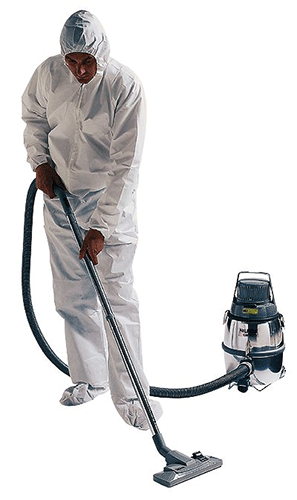 While not always sterile, a cleanroom follows accepted standards for maximum particulates per cubic meter. Air is filtered in and recirculated through HEPA air filters. Equipment is designed to generate minimal air impurities. Employees wear gloves, face masks, and head covers. Often, donning jumpsuits or smocks is also necessary. The room is cleaned daily, sometimes every few hours, according to rigorous quality procedures.
ISO Cleanroom Standards
The most commonly used standard for cleanrooms is the Federal Standard 209E. This standard refers to several classes of cleanrooms and correlates with ISO 14644-1 classes as well. For example, typical room air, classified as ISO 9, contains more than 35 million microns of particulates per cubic meter. By contrast, a Federal Standard 209E Class 100 (ISO 5) cleanroom contains a maximum of only 3,520 microns per cubic meter of particulates.
Higher purity cleanrooms raise the standard even further. A Federal Standard 209E Class 1 (ISO 3) cleanroom holds a maximum of only 35 microns per cubic meter of particulates. Consult the Institute of Environmental Sciences and Technology (iest.org) for updates in standards.
Read about what it takes to keep a clean room clean in the next blog. View our selection of Critical Environment Equipment and Supplies for Cleanrooms.
Be the first to comment on "What Makes a Cleanroom a Clean Room? (Part 1)"