
Conductivity tests a solution’s ability to conduct electrical current and serves as a quick and simple indicator of water quality. Assessing the level of water purity via conductivity can help to prevent contamination. Testing salinity levels may aid in sustaining aquatic life or signal when recycled rinse water is spent. Water measured for conductivity comes from aquariums, waste streams, cooling towers, steam boilers, or laboratory research, among other applications.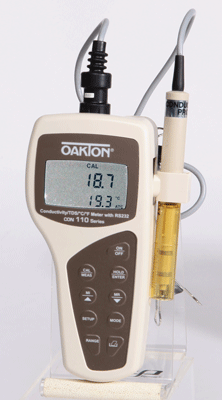
When measuring conductivity to determine the purity or salinity of a solution, consider the conductivity cell along with expected measurement range, sample type, accuracy, and general usage. While most cells included with portable or benchtop instruments will suffice, cells with cell constants (K) for high or low ranges may be a better match.
Other common considerations are cell materials (usually glass or plastic) and the number of cells (four-electrode designs are more accurate than two). Special applications such as high-purity uses in the pharmaceutical industry or boiler water in power plants require additional considerations, such as temperature coefficients and instrument resolution.
Finally, keep in mind the target species. Most organic compounds such as solvents, alcohols, oils, and sugar contain little or no ionic material and therefore are invisible to conductivity measurement, which measures dissociation of ions in water.
Watch for part two of this article, in which we discuss special applications, posted on Thursday.
View our selection of conductivity meters.
Please send your product detail. We are importer of Laboratory Equipments in Pakistan.
[email protected]
Hi:
I have sent your information forward to our international team. You should hear directly from them or one of our local dealers. Thank you.