
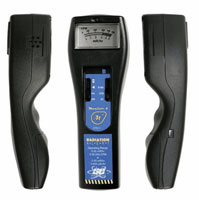
Radiation Alert Analog Detectors
Did you know Monday, November 8, was X-ray Day? The X-ray was discovered in 1895, purely by accident. Wilhelm Röntgen, a German physicist, was experimenting with electron beams on a gas discharge tube. When the electron beam was on, a nearby fluorescent screen started to glow. Thus began the journey of a technology that is used in dentistry, astronomy, research, and even laser bursts.
Because X-rays pass through muscles and other soft tissue and stop at dense materials, doctors can identify broken bones and cancers growing in the body. Electromagnetic radiation is also used in communication systems and in neutron activation analysis, allowing the identification of elements in a material.
While radiation provides many benefits to the scientific world, high levels of radiation in the environment and in food handling can be hazardous. Cole-Parmer offers Radiation Alert Analog Detectors to monitor radiation. These general-purpose detectors are available with uncompensated halogen-quenched sensors for measuring alpha, beta, gamma, and X-ray radiation; select meters have energy-compensated sensors for increased sensitivity to gamma and X-ray radiation.
All models are factory-calibrated to pulse generator and can be calibrated to ANSI standards by any certified lab. Anti-saturation circuit is good to at least 100 times the maximum reading in the highest range. No special probes are required.
Disclaimer: Cole-Parmer products are not approved or intended for, and should not be used for medical, clinical, surgical or other patient-oriented applications.
Be the first to comment on "X-ray Day 115 Years Later: Measuring Alpha, Beta, Gamma, and X-ray Radiation"