
In part one, we named three technologies for measuring dissolved oxygen: Polarographic, Galvanic, and Optical. After discussing Polarographic and Galvanic, read below for more on Optical technology.
Optical
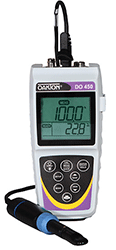 The optical detection of dissolved oxygen is based on the principle that dissolved oxygen quenches the luminescence associated with the chemical dyes in the sensor. The probe measures dissolved oxygen by emitting a blue light that causes the sensing element to luminesce (glow red). The luminescence is inversely proportional to the level of dissolved oxygen present (based on Stern-Volmer relationship). When no oxygen is present, the luminescence signal is at its maximum; and as oxygen is introduced, the luminescence decreases.
Three ways of measuring optical dissolved oxygen are the magnitude domain, time domain, and phase domain. Magnitude measures the peak height of luminescence. Accuracy degrades over time as the sensor degrades due to photo-bleaching; frequent calibration is required for this method. The time domain measures the decay rate of luminescence. Signal-to-noise ratio can limit the sensor range in this method. The phase domain (phase detector) measures the phase difference based on the entire signal and reference wave forms across a population of pulses. This method delivers the highest accuracy over the widest operating range and is commonly applied.
Optical meters provide the convenience of no membrane replacement, no electrolyte replacement, no incoming flow required, and no hydrogen sulfide interference. The meters also offer a short response time, minimal drift, and minimal maintenance. Exposure to alcohols and other organics must be limited to avoid damage to the sensor.
All three technologies offer viable methods for detecting dissolved oxygen. However, the convenience and accuracy of optical dissolved oxygen is winning over operators.
View our selection of dissolved oxygen meters.
Be the first to comment on "Three Dissolved Oxygen Technologies: Which Works Best for You? (Part 2)"