Introduction Fluoropolymers are among the most chemically inert of all polymers and remain stable in almost all chemical environments. These high performance properties are a direct result of the unique chemical structure of fluoropolymers, which differs significantly from the structure of traditional polymers such as polyethylene.
Understanding the chemical structure gives a better understanding of why the fluoropolymers have such outstanding chemical resistance (and other properties).
The basics of polymer structure All polymers are long chain molecules made up of many (between 30 and over 100,000) repeated units of a basic building block or monomer. The first part of the word monomer comes from the Greek mono meaning single and the second part comes from the Greek mer meaning part: the monomer is therefore a single part. The first part of the word polymer comes from the Greek poly meaning many and a polymer is therefore many parts - it is a collection of repeated parts in a single long chain.
The building block for the polymer is the word after the poly part of the name - Polyethylene (PE) is made of repeated blocks of ethylene joined together in a long chain and Polytetrafluoroethylene (PTFE) is made up of repeated blocks of tetrafluoroethylene joined together in a long chain.
The monomer building blocks are joined together by a process known as polymerization and the resulting long chain molecule is the polymer.
Homopolymers Polymerization of a simple polymer such as PE (Polyethylene) uses a single monomer (ethylene) and joins these together to form Polyethylene:

The polymer therefore consists of repeated units of:

and this is a shorthand notation for the polymer structure.
Polyethylene is an example of a homopolymer where all the mers are the same. If the repeat unit in the PE structure is called A then the structure of a homopolymer is:

PTFE (Polytetrafluoroethylene) is also a homopolymer and the reaction to form PTFE from tetrafluoroethylene is:

and the repeated units are:
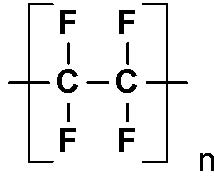
Other types of homopolymer in the fluoropolymer family are:
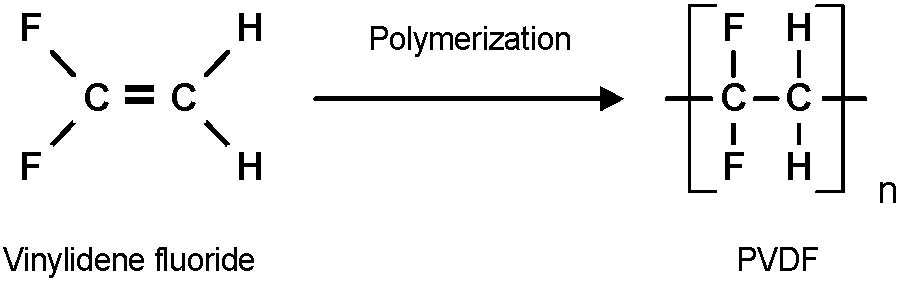
1. PVDF (Polyvinylidene fluoride) is a homopolymer and the form is:
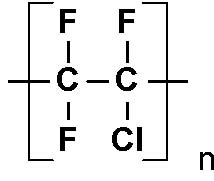
2. PCTFE (Polychlorotrifluoroethylene) is a homopolymer and the form is:
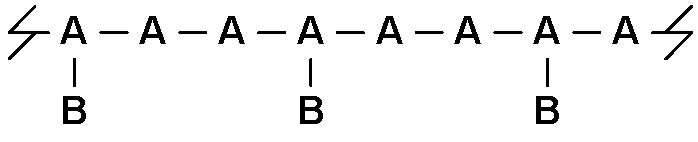
Copolymers Homopolymers are not the only type of arrangement used to make polymers. In some cases two different types of mers (A and B) are joined together to form a copolymer that has a linear structure of the form:

or a branched structure (a graft copolymer) of the form:
Copolymers are widely used in the fluoropolymer family and examples are:
1. FEP (Fluorinated ethylene propylene) is a copolymer of tetrafluoroethylene and hexafluoropropylene of the form:
2. ETFE (Polyethylenetetrafluoroethylene) is a copolymer of ethylene and tetrafluoroethylene which has the form:


3. ECTFE (Polyethylenechlorotrifluoroethylene) is a copolymer of ethylene-chlorotrifluoroethylene that has the form:

4. PFA (Perfluoroalkoxy) is a special type of copolymer where the A and B mers are not added in the same ratio and PFA has the form:

Terpolymers In other cases three mers (A, B and C) are joined together to form a terpolymer of the form:

The most common terpolymer in the fluoropolymer family is THV, which is a terpolymer of tetrafluoroethylene, hexafluoropropylene and vinylidene fluoride.
Structure and chemical resistance
PTFE — Full fluorination The chemical resistance of any polymer is defined largely by the chemical structure of the material and the strength of the weakest link in this structure.
For PTFE the only two bond types present in the structure are C-C and C-F. Both of these are very stable bonds that are difficult to break. A break in the bonds can allow chemical reactions to occur. In fact the C-F bond is one of the strongest found in polymers. This leads to the exceptional chemical resistance for PTFE.
For PE the only two bonds types present are C-C and C-H. The C-H bond is weaker than the C-F bond and can be broken more easily to allow chemical reactions to occur. This leads to a lower chemical resistance for PE. Equally the bonds found in most other polymers are combinations of other types of bonds, such as ester, amide or hydroxyl groups, double bonds or benzene rings. All of these have a much higher reactivity than the simple and strong C-F bond.
An additional factor is the packing of the polymer chains; the linear structures of PE and PTFE shown above are not really what happens in real life. The long polymer chains are not flat and straight but zigzag to fit the molecular structure into the available space. For PE the chain is effectively flat with zigzags along the length.
The PTFE chain is very different, the fluorine atom is much larger than the hydrogen atom and as a result the chain is no longer flat — it is forced into a spiral shape with the fluorine atoms packed tightly around the central C-C bonds.
These fluorine atoms then provide a protective sheath for the weaker C-C bonds and the result is the exceptional chemical resistance of PTFE.
Other Fluoropolymers The chemical inertness of PTFE is outstanding because of the chemical structure. The challenges in processing the material led to the development of other fluoropolymers with a focus on preserving the full fluorination of the backbone chain for chemical resistance, while being melt-processable for ease of processing.
The first melt-processable fluoropolymer developed was FEP or fluorinated ethylene propylene. This was developed in 1956 by DuPont. FEP is fully fluorinated and melt-processable. The full fluorination preserved the essential chemical inertness of PTFE. The changes in the structure lead to melt-processability, but as a result there is some slight loss in high temperature properties.
Other melt-processable polymers introduced since then are PVDF (1961), PFA (1972),), ETFE (1972) and ECTFE (1972). In all these cases the polymer structure does not have the full fluorination of the backbone chain that is seen in PTFE and as a result these polymers do not achieve the same chemical resistance that is seen in PTFE. As a general rule, the further the polymer structure deviates from the full fluorination of PTFE the more the chemical resistance deviates from the exceptional chemical inertness of PTFE - chemical structure largely defines chemical resistance.
Despite this, all fluoropolymers have a basic structure and chemical resistance that is far in excess of that achieved by the more traditional types of polymers. This makes them uniquely suited for applications where this chemical resistance is essential to the application.
Chemical resistance in real life In real life, the fluoropolymers are highly resistant to chemicals and do not dissolve in most solvents.
The only materials that will attack this range of materials are molten or dissolved alkali metals, such as sodium in liquid ammonia, which will extract fluorine from the molecule to leave a black (carbon) surface finish.
In addition, at elevated temperature some fluoropolymers can be attacked by fluorine, some fluorine related compounds, alkali earth and alkali metal oxides and carbonates.
Case Study: Pigment Processing 
Pigment processing is performed under conditions where harsh fluids are mixed and placed under high temperatures. During this processing phase chemicals must be as pure as possible and contain no trace of extractables. Fluoropolymer tubing is used due to its chemical inertness and its resistance to breakdown by various fluids.
A known chemical processor in the industry utilizes PTFE and FEP tubing to protect their agitators in the mixing process. Prior to using PTFE and FEP, Polyurethane was used to protect the agitators. Polyurethane was not capable of withstanding long-term exposure to the harsh fluids and caused contamination during processing. PTFE and FEP tubing is beneficial to the processor due to their chemical resistance.
Case Study: Semiconductor Industry 
In the Semiconductor Industry, contamination is measured in parts per billion. Even the smallest levels of trace elements in the critical fluid handling systems can destroy the productivity of a wafer fabrication facility. For this reason, high quality chemically resistant fluoropolymer tubing has played a vital role in the industry.
In fabrication sites - where cleanliness is critical to the process of wafer development - fluoropolymers are used for their ability to resist the leaching of extractable particles. High Purity PFA has the lowest level of metallic extractable particles and is the material of choice in the Semiconductor Industry. High Purity FEP is also used because it also possesses some of the same characteristics as High Purity PFA.
Highly corrosive fluids and gases such as hydraulic fluid, sulfuric acid, strong mineral acids, and oils are just some of the critical fluids which fluoropolymer tubing handles daily. Due to the chemical resistance and inertness of fluoropolymers, the tubing stands up to most attacks by acids and chemicals. Zeus fluoropolymer tubing meets or exceeds the demands of industries worldwide and is applied in applications where commodity plastics would fail. Fluoropolymer tubing is available in sizes from Industrial and Heavy Construction to Sub-Lite-Wall® and Roll Cover.


