Nunc certifies the adsorption capability of MaxiSorp MicroWells F, U, C, and STARWELL® on the basis of the following test procedure (where the reagent volumes apply to F-wells, other well types using volumes proportionally adjusted to their respective contents):
- Add to an 8 x 12 MicroWell matrix antibody coating mixture consisting of 3600 ng rabbit IgG (Dako Z 181) and 33 ng rabbit IgG:HRP conjugate (Dako P 128)
- per ml 0.05 M carbonate buffer, pH 9.6, 200 µl/well.
- Seal with adhesive tape and incubate overnight in the dark at room temperature.
- Wash three times (StarWell five times) with 0.15 M PBS, pH 7.2, containing an extra 0.2 M NaCl and 0.05% Triton X-100.
- Add substrate solution consisting of 0.6 mg OPD•2HCl (Fluka 78440) and 0.5 µl 30% H2O2 per ml 0.1 M phosphate-citrate buffer, pH 5.0, 200 µl/well.
- Stop substrate reaction after 3.5 to 4 minutes by adding 2N H2SO4, 150 µl/well.
- Read O.D. (Optical Density) at 490 nm against air in a MicroWell reader. U-wells are also read at 620 nm as a reference in order to eliminate any possible non-uniform extinction due to light refraction in the bottom curvatures. Consequently, dual wavelength reading is recommended in any assay using U-wells.
- Calculate the C.V. (Coefficient of Variation) for the O.D. readings of the 8 x 12 MicroWell matrix according to the following formula:
C.V. = S • 100%/X- = √ Σ (X - X- )2/N - 1 • 100%/X-
where:
S = standard deviation of O.D. readings
X- = mean of O.D. readings
X = individual O.D. readings
N = number of readings (wells)
*This expression for S is equivalent to:
√ Σ (X2) - 1/N (Σ X)2
N - 1
which is more convenient for calculation. The C.V. is a measure of the variation of the O.D. values between the wells in the matrix, and it is used as a measure of the adsorption uniformity between the wells. The smaller the C.V., the more uniform the adsorptive performance of the wells, all experimental uncertainties being equal.
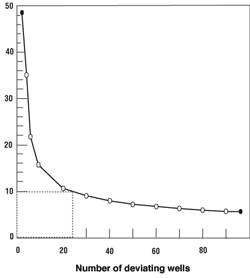
According to the procedure above Nunc guarantees a C.V. of less than 5% for an 8 x 12 well matrix of each individual certified MicroWell product. However, as can be seen from Fig. 1, the 5% criterion does not necessarily exclude the possibility of some wells having large deviations from the mean O.D. For example, if just one well deviates, the deviation may reach almost 50% without invalidating the 5% C.V. requirement. Therefore, Nunc includes another criterion for certification: the O.D. reading of any well must be within ±10% from the mean. From Fig. 1, it can be seen that these criteria in concert imply that 24 wells with a 10% deviation is the (theoretical) upper limit for product acceptance.
 | Fig. 1
Curve showing the number of wells, with a definite deviation from the mean O.D., required to produce a C.V. of 5% assuming that the remaining wells in the 8 x 12 matrix have zero deviation. The dotted lines indicate 24 wells with 10% deviation as the upper limit for product acceptance. This curve was calculated from the C.V. formula given in the text. |
Of course, the fulfillment of the criteria not only assumes certain qualities of the wells per se, but also adequate technical skill, which involves a "human factor" to be considered in the matter of C.V. reproducibility.
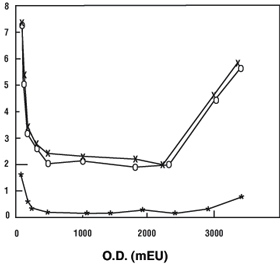
However, at very low and very high O.D. values, inevitable experimental uncertainties may cause the C.V. to exceed 5%, as demonstrated by the results in Fig. 2.
 | Fig. 2
C.V. of two 8 x 12 F-well matrices (X and O) at various O.D. values demonstrating C.V. elevations beyond the 5% acceptance level at the O.D. extremes. The curves were obtained by varying the amount of conjugate in the coating mixture while maintaining a constant substrate reaction time of 3.5 minutes. It should be noted that the same O.D./C.V. correlation was obtained by varying the substrate reaction time and keeping the amount of conjugate constant. This excludes the possibility of significant influence from conjugate dilution. The bottom curve (*) represents the C.V. due to photometric reading uncertainty alone which is also elevated at the O.D. extremes thus contributing to the total C.V. elevations. This curve was produced by calculating the C.V. from twelve measurements of the same well. This was done at various O.D. values obtained through appropriate dilutions of converted substrate in an 8 x 12 F-well matrix, one column with each dilution. Each C.V. is the mean from eight consecutive measurements in a column made by each detection channel in the MicroWell reader. |
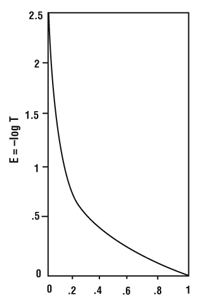
At low O.D. values, minor interwell dissimilarities in substrate conversion, liquid volumes, measuring beam alignment, etc. will cause reading deviations which are large compared to the measured values thus resulting in a large C.V. Also at high O.D. values such dissimilarities will cause relatively large reading deviations due to the very steep course of the extinction curve at the upper extreme (Fig. 3).
 | Fig. 3
The relationship between photometric light transmission, T, expressed as the ratio between the light passing through the sample and through the blank, and extinction, E, according to the definition: E = -log10T. One extinction unit, EU, is the extinction when T = 0.1, two EU is the extinction when T = 0.01, etc. Optical density, O.D., is most conveniently displayed in EU (or mEU), because this figure is directly proportional to sample concentration according to Lambert-Beer law. Note the very steep course of the curve when extinctions exceed 2 EU. |
Therefore, for the quality control at Nunc, the O.D. mean is maintained between 1200 and 1300 mEU, which is in the middle of the constant C.V. range as it appears from Fig. 2. This may be adjusted by the substrate reaction time, which is generally in the area of 3.5 to 4 minutes using Dako standard conjugate preparations.
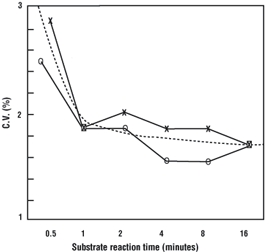
The influence of the substrate reaction time on C.V. has been checked, and the results are shown in Fig. 4. It is apparent that for reaction times longer than one minute, including the 3.5 to 4 minute range, the C.V. remains almost constant at a minimum of about 2%.
 | Fig. 4
C.V. of two 8 x 12 F-well matrices (X and O) for various substrate reaction times demonstrating that already beyond one minute, the C.V. has decreased to a minimum, leaving the routinely used 3.5 to 4 minutes well within the minimum range. The curves were obtained by proportionally varying the amount of conjugate and substrate reaction time while maintaining the O.D. within the preferred 1200 to 1300 mEU range. The dotted line is an average curve, adapted by eye. |
Part of the C.V. is due to photometric reading uncertainty, which means that the total C.V. includes the variation inherent in re-measuring one well 96 times.
The MicroWell reader has eight parallel detection channels, one for each well in a column. Assuming the same reading uncertainty on each channel, the C.V. due to this uncertainty alone has been determined at various O.D. values. It appears from the results shown in Fig. 2 that the elevated C.V. at extreme O.D. values is partially the result of enlarged reading uncertainties at the extremes. This is due to the limitations in photometric performance.
A low O.D. value is measured by the ratio between two relatively large light intensities (from sample and blank), which implies a relatively large uncertainty. A high O.D. value is the result of very little transmitted light, which also implies enlarged uncertainty because the photometric sensitivity becomes inadequate.
Although not determined in this connection, possible calibration inaccuracies between the detection channels will also contribute to the total C.V.
In conclusion, for reproduction of the Nunc-claimed qualities of MaxiSorp MicroWell products, one should observe the following precautions:
- Use well-defined, standardized chemicals.
- Keep the O.D. within the 1000-1500 mEU range.
- Use sufficiently long substrate reactions times (but be sure that the substrate conversion has not levelled off).
- Secure optimal photometer performance.
- Use dual wavelength reading for U-wells.
- Use adequate technical skills.


