There's nothing routine about taking routine temperature measurements around flammable gases and chemicals. Plant engineers, managers and technicians working in petrochemical refineries and tank farms, offshore oil rigs, and petroleum and gas pumping stations need to take special precautions in a potentially explosive atmosphere. Using infrared (IR) non-contact thermometers allows them to measure temperature quickly, accurately, and, above all, safely.
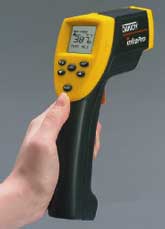 |
Intrinsically safe
infrared thermometer |
These IR thermometers use sophisticated, non-contact infrared technology, which provides near instantaneous temperature readings without the need to touch the objectan excellent solution when monitoring materials that are hot, moving, or difficult to reach. They may also eliminate the need to apply for a hot work permit, which is a real time-saver. Hot work permits often involve completing a high-level risk assessment form followed by an additional permit form. It also requires a gas test to be conducted at regular intervals in the area of the work. If repeat gas testing is required for the duration of work, an intrinsically safe infrared thermometer saves time each time and does not take a production operator away from his other duties.
OAKTON's Food Infrared (IR) Thermometer with NIST-Traceable Calibration has Factory Mutual (FM) approval for safe use in dangerous, potentially explosive, or flammable environments, and in the possible presence of acetylene, hydrogen, ethylene, or propane gases. As a result, it allows testing to be carried out in a wider range of locations with the lowest level of permit requirement.
| More Details or Order Online: |
Oakton Food Infrared (IR) Thermometer with NIST-Traceable Calibration
The InfraPro also provides: 


